What Is a CRM?
Client expectations are higher than ever. Law firms that don’t prioritize communication risk falling behind. Firms that effectively manage client relationships can operate more efficiently and grow faster through stronger reviews and referrals.
That’s where a client relationship management platform (CRM) for law firms can play a major role.
With the right CRM, firms can centralize and track their client relationships. This insight allows them to deliver a higher level of service while keeping overhead expenses low. Below, we’ll discuss what a CRM's legal meaning is and what a CRM can do for your practice.
Key Takeaways
- A CRM is software that helps your firm better manage client relationships.
- Legal CRMs are specially designed for law firms and take into account the unique security, pipeline, case tracking, and communication challenges that law firms face.
- A legal CRM can help your law firm generate more leads, convert them to clients faster, reinforce existing client relationships, and improve workflows without adding headcount.
- CRMs are effective at overcoming client communication gaps, lead management, and onboarding issues.
- Integrating your CRM with Case Status can improve your case management workflows and deliver a better client experience.
What Does CRM Stand For?
Typically, CRM stands for "customer relationship management." When this functionality is built into a platform, it can help businesses connect with customers, effectively track their journeys, and nurture leads while building loyalty.
But in the context of law firms, CRM generally stands for "client relationship management." CRM software enables law firms to manage client interactions in one centralized platform.
Given that trust, communication, and expertise are extremely important in the legal profession, a CRM is especially critical. This software can help firms deliver a consistent, high-quality client experience.
What Is a Legal CRM, and How Does It Work?
Legal CRMs specifically address the unique challenges lawyers and law firms face. For example, legal CRMs handle compliance requirements, workflows, and client management needs that are specific to law firms.
Legal CRMs better fit into how law firms actually operate compared to generic CRMs. They give teams structured intake, compliant communication, and full visibility into every client relationship.
Integration with existing legal workflows is especially critical for legal CRMs. For example, you can create contact forms that collect data most relevant to your practice areas. When a lead fills out that contact form, the CRM creates a new prospect file and directs the lead to the most appropriate attorney.
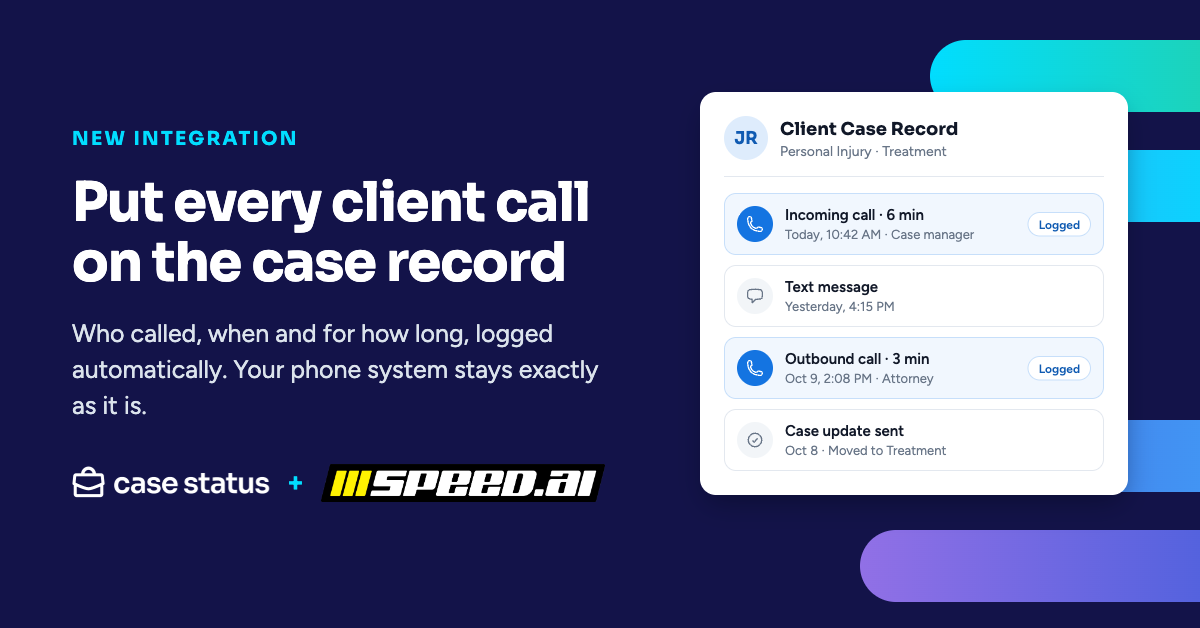
Every interaction the lead or client has with your firm, such as emails, case updates, document exchanges, and phone calls, gets automatically logged and stored in the client’s profile.
This comprehensive system allows you to easily understand the client’s full case history at a glance. That way, you can deliver faster, more personalized service without having to dig through old emails and documents.
Additionally, legal CRMs can integrate with other legal tools, allowing you to get even more value out of them. For example, Case Status integrates with many major legal CRMs. So client interactions made through our mobile app are automatically logged in your CRM. This visibility creates a seamless record and improves the efficiency of your firm.
Do Law Firms Need a CRM?
If your goal is to remain competitive while delivering a consistent client experience, then a CRM should be part of your tech stack. Whether you’re a small boutique law firm or one with multiple offices, a legal CRM delivers a multitude of benefits.
Increasing Lead Quality
CRMs help firms close the gap between marketing spend and signed clients by improving intake follow-up and visibility into your pipeline. If you find you’re spending a lot of money on marketing, but it’s not resulting in more clients, then a legal CRM could help.
For example, a CRM can help you better identify leads that are the most viable prospects. They offer customizable intake forms that can allow you to deliver faster and more personalized follow-ups. You can focus on high-quality leads and waste less time on prospects who are unlikely to convert.
With built-in analytics, your CRM shows exactly where prospects stall. With these insights, you can make informed decisions about where to make adjustments and increase spending with confidence.
Improving Client Relationships
Another pain point in many law firms is client communication. Even firms deeply committed to client service often struggle to keep up with constant status inquiries. Frequent status calls and emails disrupt casework and drain staff capacity, yet clients often expect you to be responsive.
A CRM helps resolve this issue by automating routine client communications. For example, you can use a legal CRM to send automated case status updates, check-ins, and appointment reminders. These features ensure clients feel taken care of and that their case is a priority without interrupting you and your attorneys’ workflows.
Plus, a CRM will store your firm’s entire interaction with each client. Referencing these interactions, you’ll be able to quickly catch up on their case and deliver faster and more informed responses. The result is that the client experience improves, and your firm works more efficiently without additional overhead.
Helping Your Firm Become More Efficient
A legal CRM improves your firm’s efficiency beyond automating much of your client communication. Task tracking is another powerful tool that can help improve the speed and quality of your firm’s work. With task tracking, it’s easy to ensure everyone is on the same page and that no assignments or meetings get overlooked.
With automated reminders, your paralegals and secretaries no longer have to spend substantive amounts of time on reminder calls and sending out status update emails. Instead, they can shift their attention to more high-value work that helps the firm run smoothly.
Small efficiency gains can compound quickly. They can free your team to handle more cases without adding headcount.
For example, automating routine updates can reduce administrative strain and help your team stay focused on case progression and client care. Your team can then redirect that reclaimed time toward higher-value case strategy and client engagement.
How Many Law Firms Use a CRM?
About 80% of law firms currently use a CRM, according to a report from the Legal Sales & Services Organization (LSSO). Although, adoption varies by practice area and firm size.
That high figure suggests that most law firms understand the importance of having a CRM. They see its value in increasing client retention, conversions, referrals, and revenue streams. This perceived value means CRM adoption is rising, but effectiveness depends on how well it integrates into daily workflows.
Only 20% of law firms currently using a CRM say it has been effective in helping their marketing and business development. This low figure suggests that many law firms have challenges incorporating CRMs into their workflows and getting the most use out of them.
The reasons for not getting the most out of CRMs, according to lawyers surveyed, are a lack of time, no requirement to use it, too much data entry, and a lack of understanding about a CRM’s value to the firm.
Success depends on choosing a CRM built for law firms and ensuring it’s embedded into everyday workflows, not treated as optional.
Integrate Case Status Into Your CRM Today
You’ll get the most out of your CRM when you integrate it with a client communication and case management system like Case Status. You can integrate Case Status with several leading CRMs for legal, meaning you get a single, connected ecosystem that fits seamlessly into your existing workflows.
By connecting platforms like Clio, MyCase, and Litify, you eliminate data silos and ensure every client interaction is automatically captured in one unified system.
When clients log into Case Status, their messages, document uploads, and other actions are logged in your CRM. The result is that you’ll have a complete and up-to-date view of every client’s case. From there, you can easily spot potential issues early on.
Beyond centralizing client data, integrating Case Status with your CRM also improves client communication. Clients no longer have to call your office for updates. They can receive automated notifications as their case progresses.
At any time, clients can log into their dashboard or mobile app to view their case timeline, access documents, and review messages in real time. This on-demand access increases transparency and significantly reduces inbound status calls.
Ready to see how Case Status and your existing CRM can work together to transform how your firm operates? Book a demo today to see how you can improve the client experience and help your practice achieve even greater efficiency.