Walk into almost any law firm in America and you'll find a version of the same question quietly living in the back of everyone's mind: What happens to this place when the people who built it are gone?
It's the question nobody puts on their agenda, right next to balance sheets and Q4 targets. And yet it may be the most consequential question a firm leader ever grapples with.
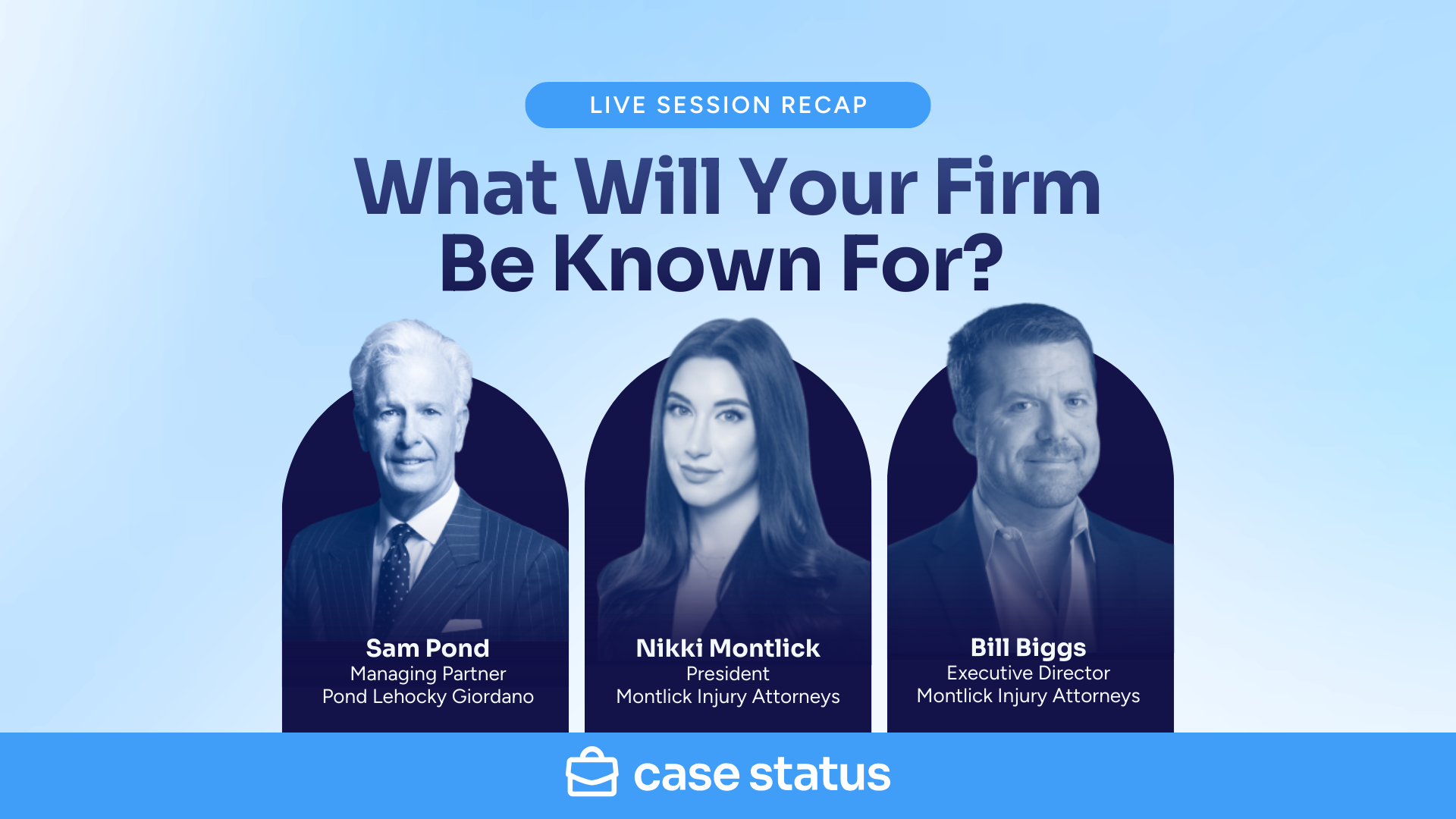
At the 2025 CX Summit, two of the legal industry's most respected firm leaders sat down with moderator Bill Biggs to tackle it head-on. Sam Pond, founder of Pond Lehocky Giordano, and Nikki Montlick, partner at Montlick Injury Attorneys, didn't deliver a polished keynote. They had a real conversation, about values, about clients, about the responsibility that comes with building something meant to last.
Here's what they said, and why it matters for every firm leader thinking about what comes next.
Legacy Isn't About Bloodlines. It's About Values.
The session opened with a simple show of hands: how many people in the room came from a firm where ownership had passed through family lines? About 5% of hands went up.
Sam Pond didn't miss a beat. "Legacy doesn't mean you have to have a family member in your firm. It's about your firm. It's about the values you created."
That reframing set the tone for everything that followed. Whether your firm is a founder-led startup or a 41-year-old family institution like Montlick Injury Attorneys, legacy is something every firm is building, whether they realize it or not.
Nikki Montlick, who started working at her father's firm at 15 years old, in the mailroom, answering phones, working through law school, described the weight of that inheritance not as a burden but as a standard. "It was always something we talked about in my family. It was a really great source of pride."
The question isn't whether your firm has a legacy. It's whether you're being intentional about what that legacy will be.
The Three-Minute Test for Your Core Values
Midway through the session, moderator Bill Biggs posed a question that stopped the room.
If you had three minutes, the last three minutes you'd ever have with your child, your successor, the person who's going to carry this firm forward, what would you say? What would you spend those three minutes on?
He then turned to the audience: "Whatever those three minutes would be... those are your core values."
It's a deceptively simple test. Most firms have a core values statement. Most firms can't recite it without looking it up. And most of those statements, if we're honest, are a collection of buzzwords assembled during an offsite that nobody has thought about since.
Nikki's answer was immediate: integrity. "Every single decision that you are making should be, am I making a decision with integrity? Is this going to be the best thing for the client?"
That's it. Not a framework. Not a five-point model. One question that drives every hire, every case decision, every moment of friction.
Sam put it this way: "If you've built something that you believe in, that you want to continue because it makes a change in our society, you have to prepare for it to carry on. And some people don't think about it. Just like they don't think about their balance sheet."
Client-First Isn't a Slogan. It's a System.
Both panelists returned again and again to the same theme: the firms that endure are the ones that operationalize client care, not just talk about it.
"The client is number one, the firm is number two, and you are number three," Nikki said. "That is the mentality we make every decision with."
But she was equally clear that this doesn't happen through mission statements. It happens through people. "It's your people that are going to be the game changers in your business. Hiring is the hardest thing you're going to have to do."
Montlick Injury Attorneys has passed on candidates with exceptional trial records and impressive pedigrees because the values didn't align. Skills can be taught. Processes can be learned. Values can't be installed after the fact.
Sam echoed the same conviction, and connected it directly to client outcomes. "If you take care of the client, everything else will take care of itself. You'll be fine financially. Everything else will take care of itself."
It sounds simple. It isn't easy. But the firms that have been doing it for decades know it to be true.
Change Isn't a Threat to Legacy. It's Part of It.
One of the sharper moments in the session came when Sam addressed the elephant in every room full of law firm leaders right now: technology, AI, and the pace of change that isn't slowing down.
His position was unequivocal. "As a leader, the legacy of your firm has to be the mindset that change is part of our DNA."
He used their adoption of Litify as an example, one of the early firms to make the move. "You have a choice. Change is good. Or I know you have to leave that old jalopy. But we've got this thing called a combustible engine now." If you don't adapt, he said, "the competition is going to run us over."
Nikki framed it differently, not as disruption to resist, but as a lens to apply: "We ask every question before we make any decision: is this going to benefit the client?"
When applied honestly, that question makes technology decisions easier, and makes it easier to say no to the shiny tools that don't actually move the needle.
Technology Should Enhance the Human Connection, Not Replace It
In an industry being bombarded with AI pitches and automation promises, one of the most grounding moments of the session came from Nikki's reflection on what she actually learned growing up inside her firm.
"I really learned the importance of human connection in a case... despite having all these wonderful technologies that we want to implement, how can we use that technology to reinforce that human connection? Because that's really everything at the end of the day."
Sam described how Case Status had been a "game changer" for Pond Lehocky, not because it replaced human interaction, but because it freed their best people to focus on white-glove service. "It's really allowed us to have client referrals disconnect up... your ability to have amazing client satisfaction."
The framework is straightforward: when clients are informed automatically, staff stop spending their days answering "what's going on with my case?" calls. That bandwidth gets redirected to the relationships that actually matter, the ones that generate referrals, loyalty, and the kind of reputation that outlasts any marketing campaign.
Supporting Your Staff Is Supporting Your Clients
It would be easy to read a conversation about legacy and client experience as being entirely about the client. But both panelists made a point of pulling the camera back.
"You not only have to think about how we can have really wonderful client experiences where they feel like they're connecting with you on a human level," Nikki said, "but how can you also nurture your staff and cultivate an environment of calmness, of constructive feedback rather than being punitive."
The legal assistant job is hard. The case manager job is hard. Day in and day out, these are people absorbing the stress and urgency of clients going through some of the worst moments of their lives. If your staff is burning out, your client experience is burning out with them.
Firms that build legacies understand that the pipeline runs both directions: happy, supported staff create better client experiences, which create more referrals, which create a healthier firm, which allows you to support staff better.
Protecting the Profession Is Part of the Legacy
Sam closed with something that went beyond individual firms, and it resonated.
"We are a team of rivals. We are all competitors, but we're still a team. What a bad advertiser does, something bad, that affects us."
Legacy-minded law firm leaders aren't just thinking about their own balance sheets and succession plans. They're thinking about what the profession stands for. What the industry looks like when clients, legislators, and jurors are watching. What they're contributing to the larger system that gives consumers access to justice in the first place.
"We help people in their most dire time of need," Sam said. "It's an honor to do what we do."
That's the floor. And for firms that want to build something lasting, it's also the ceiling.
What Will You Say in Your Three Minutes?
The session ended the way it began: with that question.
Whatever you would say in those final three minutes with your successor, why aren't you saying it now? Why aren't you building around it today?
Legacy isn't something that happens to a firm. It's something firm leaders choose, reinforce, and protect — every day, in every hire, every client interaction, every technology decision.
The firms that get this right don't just survive change. They define what comes next.
Want more conversations like this one?
The 2026 CX Summit is coming, and if this session is any indication, you won't want to miss it. Sign up for early access to be the first to know about speakers, dates, and registration.