There's a question that should keep every managing partner up at night — not about case outcomes, not about billable hours, but about this:
You’re doing good work. Your clients know it. The question is whether your systems are letting that work speak for itself — in reviews, referrals, and the day-to-day experience of being your client.
Not in the legal sense. Not "do they believe you're competent." But in the human sense — do they feel informed, respected, and cared for between the moments that matter?
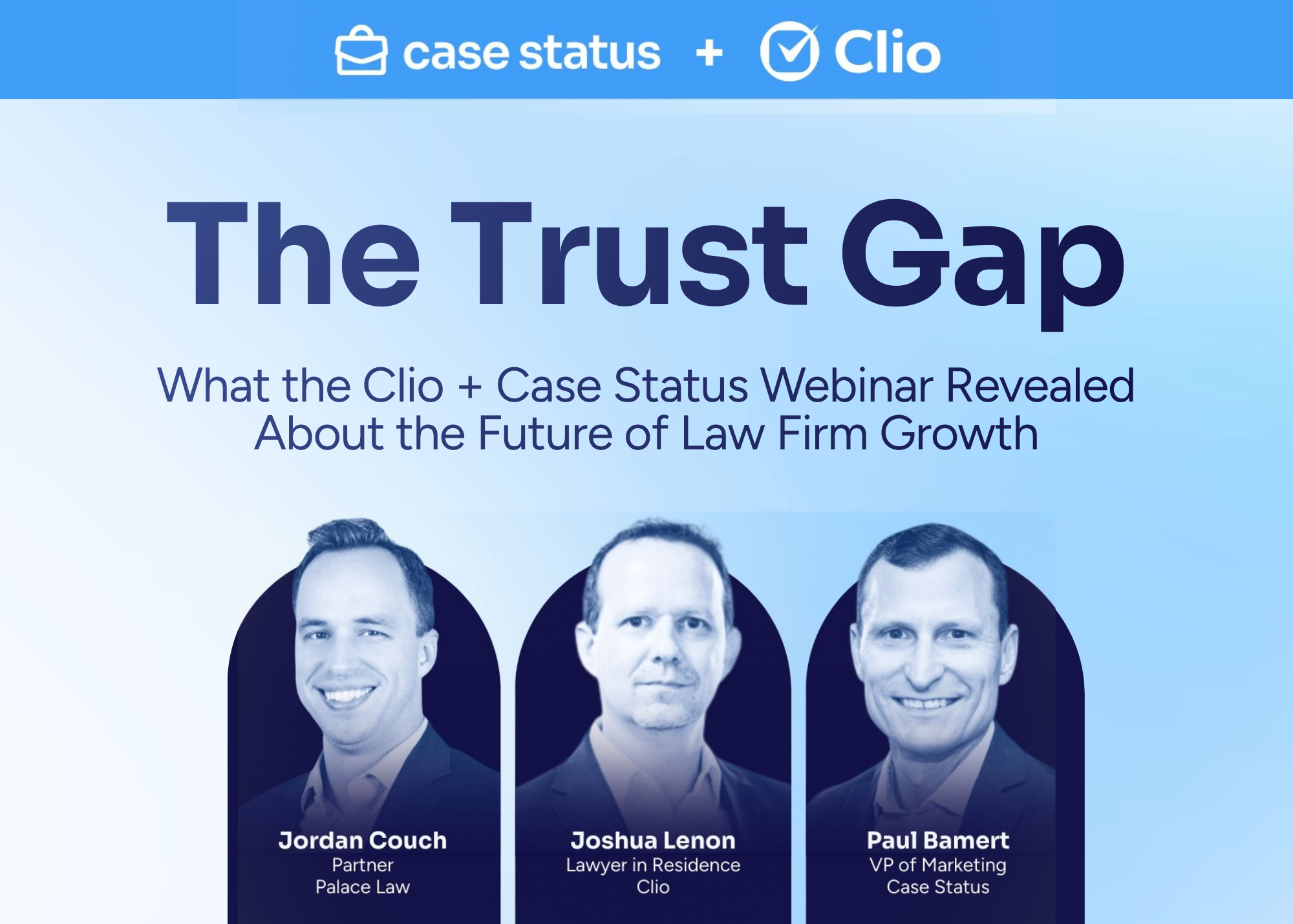
Last week, Case Status and Clio brought together firm leaders, legal industry researchers, and practitioners from Palace Law, Quill & Arrow, and Freed Marcroft to wrestle with exactly that question. What emerged wasn't just a conversation about communication tools. It was a frank diagnosis of a structural problem that has been quietly eroding law firm growth for years.
Here's what we learned.
The #1 Bar Complaint Hasn't Changed in 20 Years — And That's the Problem
Communication failures remain the leading source of bar complaints. Two decades of legal technology, practice management software, and client portals later — and the number hasn't moved.
That's not a people problem. It's a systems problem.
The firms showing up in those complaint statistics aren't staffed by lawyers who don't care. They're staffed by lawyers and teams who are genuinely trying — but who are using tools built for a different era of client expectations. Tools that were designed to store and display information, not to build trust.
Joshua Lenon of Clio put it clearly: the data from the annual Legal Trends Report shows that prospective clients expect a response within 24 hours. Most firms aren't hitting that mark. And when expectations aren't met at the very beginning of the relationship, trust starts eroding before the engagement even begins.
The Trust Gap Is Real — and It's Widening
We use the term "trust gap" deliberately. It's the distance between what your clients expect and what your firm actually delivers — not in legal outcomes, but in the day-to-day experience of being your client.
Today's legal clients are the same consumers who track their DoorDash order in real time, check their Uber driver's location before they leave the house, and receive proactive shipping updates before they even think to ask. They bring those expectations into your intake process, your case updates, and every interaction in between.
When those expectations aren't met, clients don't always say something. They just quietly lose confidence. They call more. They email more. They refer less. And when the case is over, they don't leave a review — or worse, they leave the wrong kind.
The firms that are outperforming their peers right now understand this. They've stopped treating communication as a task to manage and started treating it as infrastructure to build. The difference between those two framings is enormous.
Why Portals Alone Can't Close the Gap
For nearly a decade, the legal industry's answer to communication problems has been the client portal. And portals have done something — they've created a place for documents to live and a nominal channel for updates to travel through.
But portals are passive. They can display information; they can't surface urgency. They can store a message; they can't tell you a client's sentiment is declining. They can send a notification; they can't prevent a bar complaint.
More importantly, portals were built for lawyers and staff — not for the mobile-first consumer who spends five hours a day on their phone, 93% of that time inside apps. Browser-based portals that require a login, a password reset, and a desktop to navigate aren't meeting clients where they are. They're asking clients to meet the firm where it's comfortable.
The result: adoption stagnates. Staff compensates. The communication problem persists — it's just slightly more organized.
What Leading Firms Are Doing Differently
The firms that appeared in our webinar — and the hundreds of firms we work with across the country — share a common shift in mindset. They've moved from reactive communication to proactive experience design.
That means a few specific things in practice:
They've operationalized the client journey. Instead of leaving communication to the discretion of individual staff members, they've mapped the key moments in a case where clients need information, reassurance, or guidance — and automated delivery around those moments. The client gets a proactive update before they think to ask. The anxiety call never happens.
They measure what matters. NPS isn't just for Fortune 500 companies. The firms winning on growth are tracking client satisfaction at every stage of the matter — not just at close. Why? Because a low score at intake is a churn risk you can address. A low score at resolution that goes unmeasured becomes a bad Google review.
They've connected operations to experience. Clio powers the operational backbone — matter management, billing, workflow. Case Status powers the client-facing experience layer on top of it. Together, they create a single source of truth for the client relationship: the firm knows what's happening, the client knows what's happening, and nothing falls through the gap between the two.
They treat reviews and referrals as outcomes, not afterthoughts. The hiring decision for most legal consumers comes down to two things: online reviews and direct referrals. Firms that systematize the process of converting happy clients into both have a compounding growth advantage that traditional advertising can't replicate. One firm we work with grew from 417 Google reviews to over 3,000 in two years — not by asking harder, but by asking smarter, at the right moment in the client journey.
The Reputation Protection Most Firms Overlook
There’s a layer to this conversation that goes beyond growth. Firms that build proactive, documented communication systems aren’t just winning on reviews and referrals — they’re protecting the firm itself.
Communication failures remain the #1 source of bar complaints — not malpractice, not billing disputes, but clients who felt left in the dark. The firms that solve this problem don’t just grow faster. They create a documented record of every touchpoint, every update, every satisfaction signal. That record is a growth asset. It’s also a risk management asset.
When you’re proactively keeping clients informed — and you can prove it — you’re not just building a better client experience. You’re building a firm that’s harder to attack and easier to recommend.
The Strategic Choice Ahead
Every managing partner reading this faces a version of the same decision. You can continue operating in a model where communication is managed reactively — where staff handle inbound questions, portals go underused, and reviews trickle in by chance. It works, to a point.
Or you can treat client experience as a strategic asset. You can build systems that scale without adding headcount. You can measure trust and act on it before it erodes. You can turn your happiest clients into your most effective marketing channel.
The firms choosing the second path aren’t doing it because it sounds good. They’re doing it because the results are unambiguous. One PI firm grew from 417 Google reviews to over 3,000 in two years — with referrals climbing from one per day to five or six. A Social Security disability firm doubled its caseload from 350 to 700 cases with the same team of five. A workers’ comp firm added over 1,000 cases without a single additional hire.
The trust gap is real. But it's also closable.
The question is whether your firm closes it on purpose — or lets a competitor do it first.
See What This Looks Like for Your Firm
If the ideas from this webinar resonated, the next step is a conversation. We'll show you exactly how firms like yours are using Case Status and Clio together to close the trust gap, free up their teams, and build the kind of client experience that drives sustainable growth.

.png)