


Last week at the Great Legal Marketing Summit in DC, Joseph and Nora Shannon of Shannon Law Group walked up to our booth and introduced themselves. They are Case Status® customers, they were on my list of people I wanted to meet, and I knew they were coming. I'd just never met them in person.
After the hellos, Joseph threw me a curveball.
"So, how are we doing?"
"What do you mean, how are you doing?”
"How's my firm doing with Case Status?"
The answer I used to give
Not long ago, my honest answer would have been: "I have no idea. Let me check with our chief customer officer, or your implementation manager, or your CSM, and I'll get back to you." A few days later someone would have sent a summary or set a meeting. By then the moment at the booth is long gone.
Every firm I talk to knows that feeling from the other side. You have a question about your own clients, and the answer lives somewhere in your data. Getting it out means finding the one person who knows where to look, and then waiting.
What I did instead
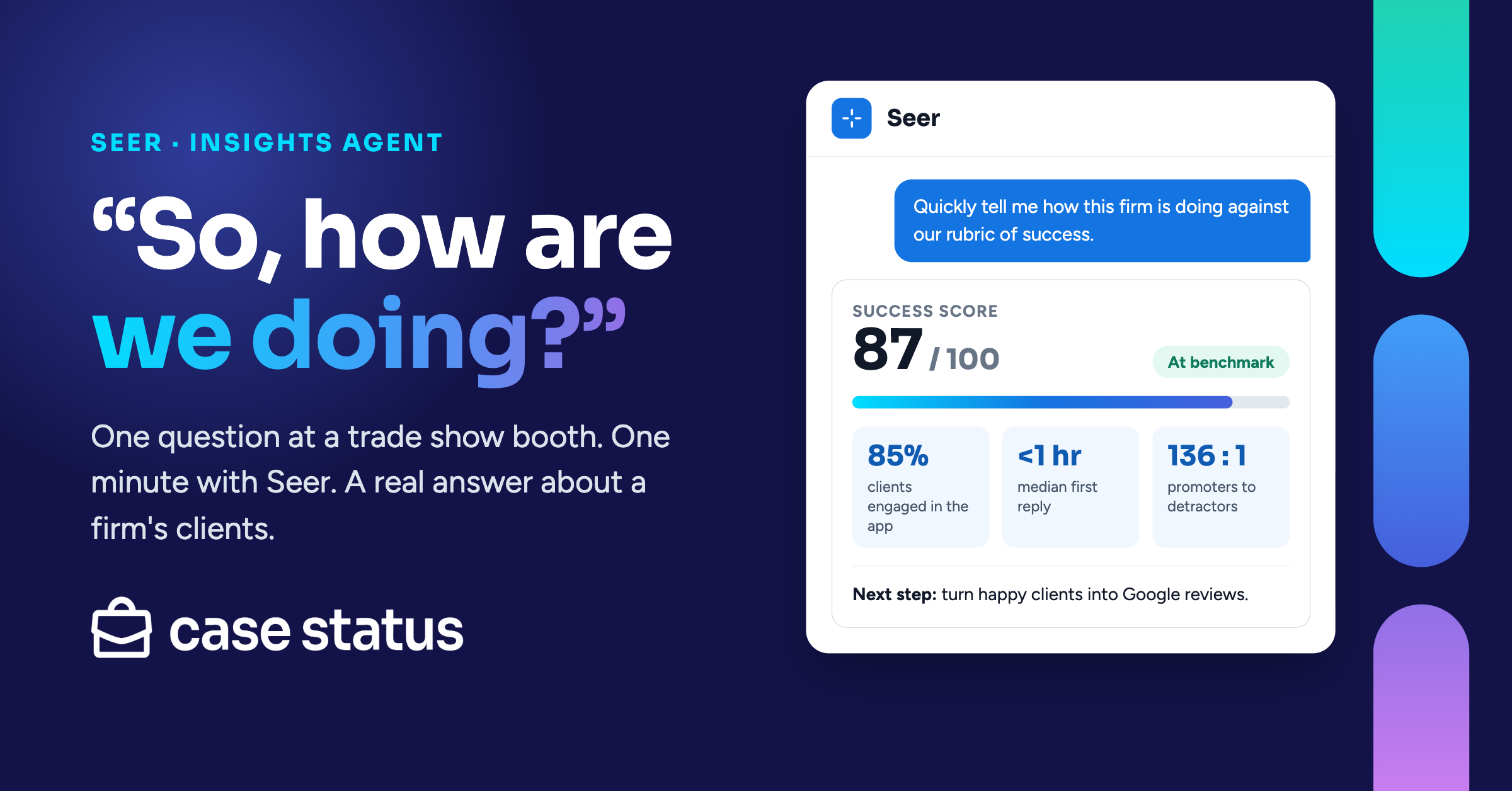
This time I didn't think twice. I opened Seer, the Insights Agent built into Case Status, and asked the same question. Actually, I went a little deeper. Here's roughly what I typed:
"Joseph Shannon just walked up to our booth. I'm the chief marketing officer at Case Status. I have no background on his law firm other than knowing they're a customer. Quickly tell me how they're doing against our rubric of success: connecting staff and clients on a common platform with high adoption, building trust with their clients, simplifying the work for their staff, and driving growth for the owners and managing partners."
About a minute later, Seer came back with a story, complete with charts. Shannon Law Group scored 87 out of 100, right at the benchmark. 85% of their clients on open cases were engaged in the app. Their median first reply to a client was under an hour. 136 promoters to a single detractor. And one clear place to grow next: turning all of those happy clients into Google reviews.
Joseph and Nora loved it. And standing next to us was a prospect, not yet a Case Status customer, who watched a real firm get a real answer about its own clients in the time it takes to pour a cup of coffee. It was the best demo I've ever given, and I didn't demo a single feature. I asked a question.
You can have a serious conversation with your data
That's the part I keep coming back to. We put a lot of information in front of firms: dashboards, reports, scorecards. All useful. But the best ideas don't show up as a report request. They show up as a question in the middle of a conversation, and until now there was nowhere to take that question in the moment.
That's what Seer is for. It's the surface that gets you into your data and helps you connect dots that weren't connectable before. Ask one question, and the answer gives you three more ideas. Ask those too.
I'm not the only one who has seen it.
Live on stage, unrehearsed
At our CX Summit in Charleston this fall, our CEO Andy Seavers invited Brian Page, chief legal officer at Trust Guss Injury Lawyers in Houston, on stage to ask Seer about his own team, live, with no rehearsal.
Brian’s team doesn’t just use “trust” in their namesake. They invest in the client experience and deliver trust every step of the journey.
The first question was a big one: show staff members with more than 50 assigned cases, ranked by response time and Net Promoter Score. Brian spotted right away why one name topped the list. She handles medical records and touches nearly every case in that phase. So they narrowed the question to case managers, and the answer matched what Brian already knew about his standouts.
That back and forth is the point. When the first answer isn't quite right, you don't file a new request. You ask a better question.
Brian also knows why those answers matter. The signals Seer reads come from how clients actually use the platform, and some of them are hard to forget.
"It's the clients logging in in the middle of the night to check on the status of their case," Brian said. "Something woke them up in the middle of the night and they are checking on their case."
That's why he pushes back when people call Case Status a texting tool. "If you're thinking about Case Status as a texting platform, you're going about it all wrong. It really is a client experience platform."
"Give me a report on XYZ"
Tom LaSpada, intake manager at Quinn Law Group in Philadelphia, also is hyper focused on client experience, and knows that the first impressions are the most important, but also that marketing’s best asset is happy client alumni. Quinn Law Group invests heavily in this experience of the client.
Tom already has his list of questions ready. Before, staying close to every client meant a lot of manual work.
"A lot of this was manual before, whether that be a text message from the case manager, 'How's your treatment going? How are you doing?', or a phone call from our case manager going out every two weeks," Tom said. "When you're a smaller to mid-size firm with a smaller team, it's really hard to check in on every client."
Now he wants answers on demand. "Data reports, as boring as some people might think they are, are the best thing you can do to grow a firm and analyze performance. Being able to go into Seer and say, give me a report on XYZ, and tailor it to the needs of your firm, is going to be a huge time saver."
He's thinking bigger than a single case: which clients are likely to leave a great review, and which team members deserve a shout out. "Everyone sometimes focuses on the negatives," Tom said, "but you also want to celebrate your team members."
The part no software does for you
Brian closed his time on stage with a reminder I agree with completely. Tools only help if your team trusts them and uses them.
"Client experience is directly affected by the way that you manage the change that you're bringing into your firm," he said. "If your people are not adopting it, that's going to trickle down and completely affect client experience."
Start with a goal, then work backwards
One thing I'd steer you away from: don't use Seer to do what Case Status already does for you. Triage already tells you which cases need you today. Case summaries already catch you up on a client. Recommended responses and translation are already right there in the thread. You can ask Seer those things, but you don't need to.
Seer is for the bigger questions, the ones no screen was built to answer. Joseph started with the biggest one there is: how are we doing? Do the same. Take a step back and start with a goal.
Every firm I talk to wants the same two things: more reviews and more referrals. So ask exactly that:
"What do I need to do to get more reviews and referrals?"
Then work backwards from whatever comes back. If Seer tells you that you need more 9s and 10s, ask where your 9s and 10s come from. If it tells you that not enough people are asking, ask who on your team is asking for reviews and referrals and who isn't. Then ask which of your happiest clients have never been asked at all. Every answer points to the next question, and a few questions in, you have a plan you can hand to your team on Monday.
Seer is live for every Case Status firm. Open it from the top right of the web app, or press Cmd or Ctrl + J in the Chrome extension, and start with your goal.
Want to see it first? Watch the replay of XOS Open Office Hours: Seer, where Brooks Bevins walks through it live.