

Your firm spent eighteen months on the case. Your client watched every stage move. They got the updates, asked the questions, saw the work. By the time you settled, they trusted you.
Then the case closes and the experience falls off a shelf.
A phone call to confirm the mailing address. A check printed, signed, stuffed, and mailed. A week of "did it come yet?" calls that your case manager fields while working the next hundred files. And at the end of it, a client who has to find a bank branch to deposit a piece of paper.
Every other part of the case moved into the modern era. The last five feet did not.
More than just a workflow
On the surface, integrated digital disbursements looks like a workflow tool. And in many ways it is: it dramatically reduces the overhead of sending hundreds or thousands of paper checks a month. We talked to one firm that was saving over a hundred thousand dollars a year on their FedEx bill alone, because they had been overnighting checks. There is a decent chance that is happening somewhere in your office right now.
But it’s also so much more than that.
The next generation of plaintiffs does not want to wait days for a check, and they do not want to deal with the hassle of cashing it. For many firms, this is the most important reason to move to digital disbursements, and it is why we wanted to work with Case Status®, a company that has been leading our industry into a more modern client experience for years,, and why we are genuinely excited that payments are now part of the Case Status Experience Operating System (XOS).
The cost savings are real, but they are not the headline. The headline is that the moment a client receives their money is the most emotionally loaded moment in the entire matter, and most firms are currently handing that moment to the postal service.
The channel is the feature
Digital disbursements are not new. Many firms are already using Confido to send a client a payment link by email or text.
The difference is where the link lands.
When the link arrives inside Case Status, it arrives in the thread they have been using for eighteen months, with your firm's branding on it, in an app they have already opened dozens of times and already trust. There is nothing to verify. They already know it is you.
That is an adoption argument as much as a security one. If you want clients to actually use digital payments, the most reliable way to get there is to put the payment in the channel they are already using to talk to your firm. The added protection is that clients have to log into the app to get paid, which is a real layer beyond a link sent by email or text.
There is a second security dividend, and it runs the other direction. Your team never collects the client's bank details. No routing number written on a legal pad, no account number sitting in an inbox. The client enters their own information directly with Confido. Firms that want more can turn on enhanced verification, which checks that the name on the client's bank account or debit card substantially matches the client on the case.
Some firms were not waiting for us
The best evidence that this was a real problem is that firms built their own version of the solution before either company shipped one.
Levinson & Stefani Injury Lawyers, a plaintiff firm in Chicago, has been a Confido customer and a Case Status customer for years. They did not wait for the two to talk to each other.
"We have been using Confido since I met Jon and Emery at the first CX Summit, and we loved it right away. But we had already built our own template message in Case Status, so our firm admin was pasting the Confido link into it by hand, one client at a time. We were the integration before the integration. We did it that way because we could see what it did for clients, and it was worth the extra lift on our end.
Here is what I would say to another managing partner. Your client does not remember the demand letter. They remember how the last week felt. If a case that went well ends with a phone call about a mailing address and a check that arrives whenever it arrives, you have spent a year earning trust and then handed the ending to the post office.
When the money shows up in the same place they have been talking to us the whole time, nobody has to call the office to ask whether it is real. Nobody is reading their account number out loud to a paralegal. It just works, and it works in the one moment they are most likely to tell somebody about us. That is not a payments feature. That is the whole relationship landing well."
Jay Stefani, Managing Partner, Levinson & Stefani Injury Lawyers
That is what the integration automates. The difference now is that nobody has to remember to paste anything.
What it actually is now
Case Status Payments is the disbursement capability inside Case Status, powered by Confido. The short version:
It takes less than two minutes to integrate the two tools using the Confido API. There is no data migration and nothing changes about how your case management system works.
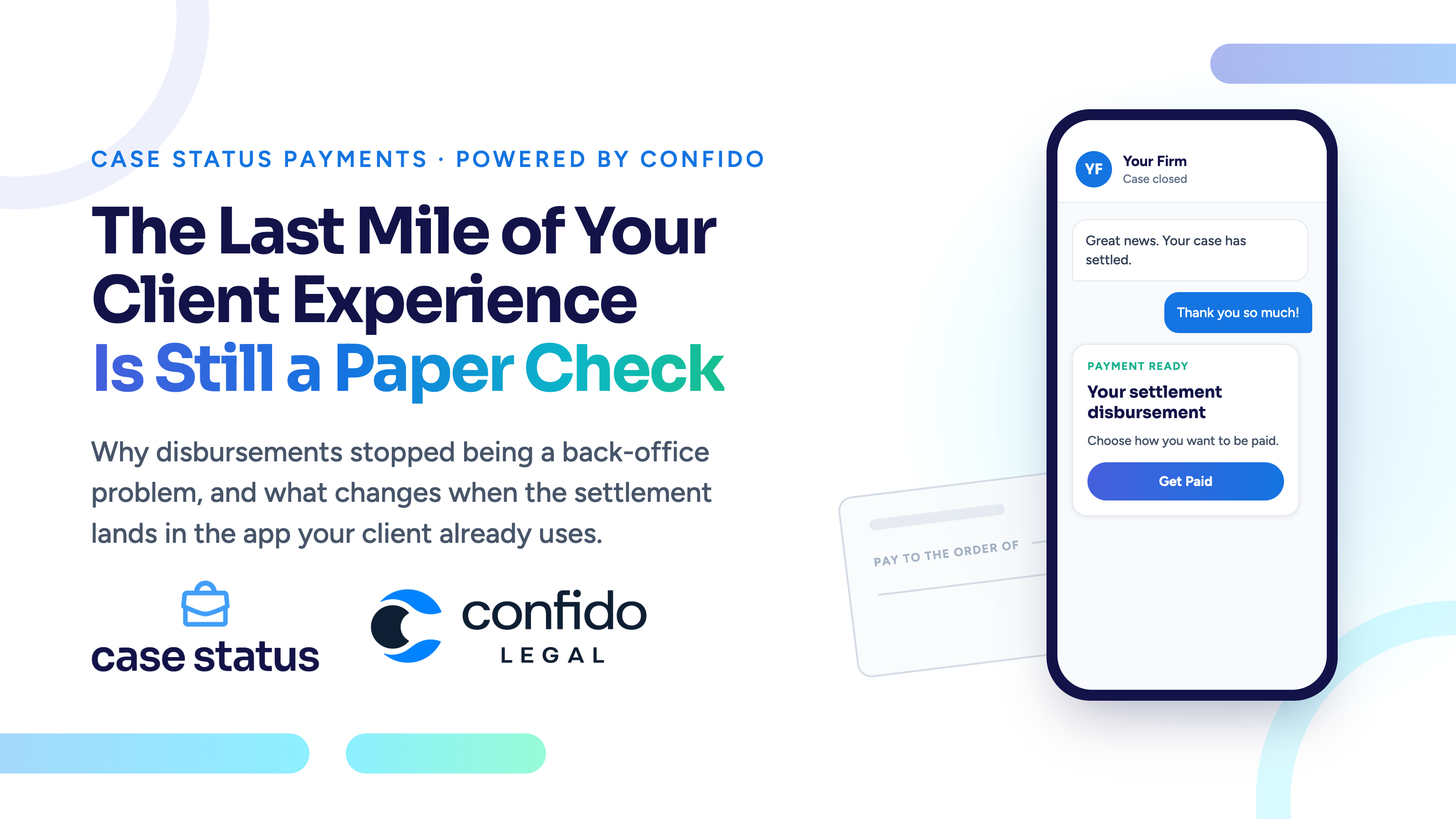
When funds are ready, your team sends the disbursement from inside Case Status. Your client opens the thread they already know, chooses how they want to be paid, and the money moves digitally. It is documented back in your case management system like everything else, so nothing is lost on the accounting side.
One honest note about where this sits relative to your case management system. Confido integrates with a lot of platforms, and if you already run disbursements through one of them, that connection likely leans toward the accounting workflow. It works. Routing the disbursement through Case Status is a different choice with a different emphasis: putting the payment in front of the client in the channel with the highest adoption.
Why we wanted to be inside XOS, not bolted to the side of it
When Andy Seavers introduced XOS from the main stage at CX Summit, I was in the room. I had come off that same stage an hour earlier. What struck me was how little of the announcement was about any one feature.
XOS is one system to manage the full experience a law firm delivers between signing a client and earning their referral. That span is the whole idea. It pulls together the operational record a firm already produces- status, milestones, timelines, every touch on the matter, and sets it next to how the client actually feels about all of it. Then it puts a recommendation in front of the person who can act, before the case stalls and before the client goes quiet.
Triage. Call integration. Reviews. Seer. Those pieces were already in place.
What was missing was the end of the story.
If you build a system that runs from signature to referral, you cannot stop at the verdict or the settlement figure. The client's experience does not end when the case does. It ends when they get their money. And that moment sits directly between everything your firm did and the decision the client is about to make about whether to send you their cousin.
Dropping a paper check into the middle of that is not a small gap. It is the gap, and it falls at the worst possible place.
Case Status Payments closes it. That is why being part of this ecosystem matters more to us than another logo on an integrations page. The work your firm does before the client signs, and the referral you earn after the case closes, are connected by a single thread. We want disbursements tobe a part of that thread, not a detour off it.
A word on the ethics rules
Every state handles disbursement rules a little differently, and "can I actually do this" is the first question most managing partners ask. Fair question, and the answer is yes. Confido and Case Status built a co-branded guide breaking down disbursement rules in every state, and why they don’t prevent firms from sending client money digitally.
If you want it before the session, ask and we will send it over.
Join us Wednesday
We are going deep on all of this in Session 4 of XOS Launch Office Hours: Disbursements and Payments, with Confido.
Wednesday, October 21, 2026, 12:00 PM Eastern. Register at casestatus.com/events/xos-launch-office-hours.
I will be there with the Case Status team. Bring all your questions, around ethics or anything else.
One more thing worth knowing before you come. Confido is waiving firm-facing fees through the end of 2026 for firms that sign up through Case Status. You can turn it on, send a single disbursement, and see how it feels. Try it once. If it works, try it twice. It lends itself well to testing, which is the best argument I know for a tool that touches client money.
Your client's last memory of working with your firm should feel at least as good, if not even better, than the rest of the case did.