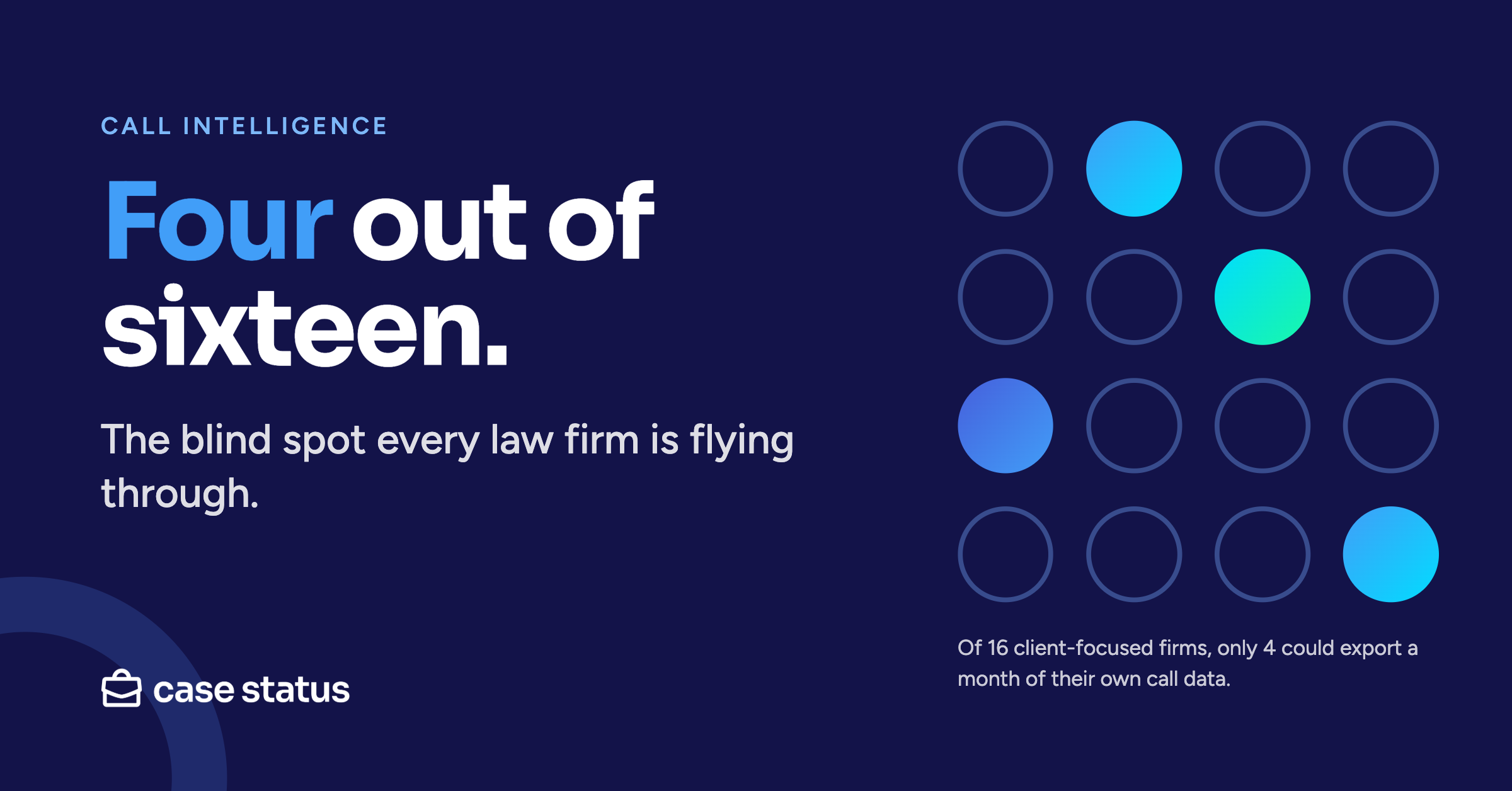
Last spring, Case Status® brought 16 law firms together for our Client Experience Mastermind.
Before the session, attendees were given a homework assignment: export one month of data from your phone system. Dates, numbers, call lengths. Recordings if you have them.
Turns out only four firms could do it, and one of those four got it to us at midnight the night before.
These were not struggling firms, they were some of the most client-focused practices we work with. Every one of them had a phone system and most of them were recording calls. They all agreed that a large subset of client engagement was captured in these calls. The data existed, it just lived somewhere nobody looked.
That’s the blind spot.
Every channel leaves a trail if you listen.
Think about everything that already lives in a client’s case. Texts. App messages. Documents. Appointments. Review requests. If a client says something in writing, someone on your team can find it, act on it and prove it happened.
Now think about the phone. It’s still where your clients go when they’re worried, confused or upset. It’s where they tell a paralegal the thing they’d never put in a text. And when the call ends, it lives in one person’s memory, until the next call starts and pushes it out.
Firms tell us the same story over and over:
They close that call, pick up the next one, and notes don’t get documented right away or at all. And if they do get documented, they are only part of the overall story.
You can rely on people to take notes. You can’t rely on somebody to leave a holistic note that captures all of the essence of the conversation. We don’t think this is really a people problem. Your team is taking calls all day and working a heavy case load so process or thoroughness can get dropped. But what if AI in our existing tools can now do those steps for us?
Flying by sight
Andy Seavers, the Case Status CEO and co-founder, is a pilot, and he describes it this way: new pilots learn to fly by sight: look out the window, read the horizon, trust your eyes. That works fine on a clear day close to home.
Commercial pilots fly by instruments. They learn to trust the data in front of them, because the stakes are too high to rely on what they can see. It’s a big part of why commercial flying is so safe. Commercial pilots fly by instruments even when it is sunny and clear.
Most firms still run client care by sight. You look around, you notice the clients who are loud, and you respond to the squeaky wheels. That works until you grow, and then the quiet clients start slipping past. This will limit how far a firm can scale with client experience.
So why does closing the blind spot matter? Why does holistic client experience matter? As costs to acquire clients via traditional advertising methods continues to increase due to bigger players outspending the market, the endgame for legacy firms looks grim. But firms who care about client service have an option. They don’t have to outspend the larger firms penetrating their markets, they can differentiate on client experience. By closing the blindspots, these firms can drive sustainable growth via happy customers - reviews and referrals. The gap shows up in the numbers.
What it looks like when someone is listening
Here’s an example Andy shared at AI Era 2.0 last week.
A normally quiet client calls in. She mentions that her doctor recommended an MRI, and she decided not to get it. On a busy afternoon, that detail could easily die with the call. Any PI attorney reading this knows it’s a red flag.
With Call Intelligence in the Case Status Experience Operating System (XOS), the call lands on her case within minutes. A summary of the call catches the comment about the MRI and her sentiment reads negative. Triage flags this case as needing attention and moves her case up the list for action. Because all of this information was captured on her case, the context is there and a suggested reply is waiting for her paralegal to review and send: we heard you, this matters for your recovery and your case, can we help you get it scheduled?
The paralegal sends the note. The client schedules the MRI and reports it back in the app. Nobody had to remember. Nobody had to discover the fire on their own after the fact. But the truth is, the paralegal is the hero because they avoided the fire in the first place, kept the case and the client on task, and did it with the human touch.
From the call happened to what the call meant
This fall we connected client calls to the case. That closed half the blind spot: you could see who called, when and for how long, and play the recording.
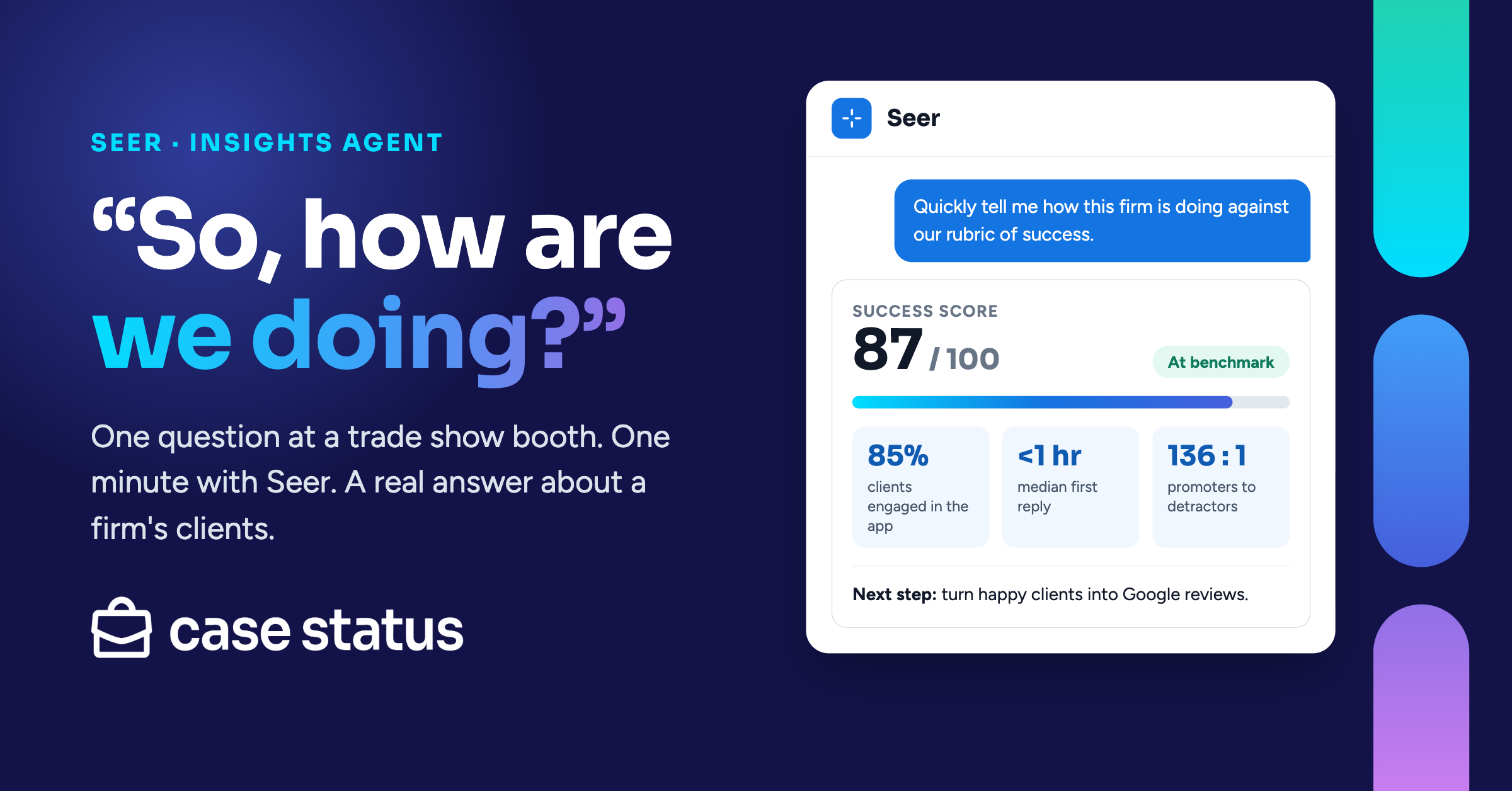
Now, Call Intelligence closes the other half. For every recorded call, XOS now tracks missed calls, writes the summary nobody had time to write, keeps the full transcript, and predicts how the client felt. To make all that metadata actionable, now a rough client call may get flagged in Triage for extra support. Suggested replies know what was said on the phone, so you never ask a client for something they already told you. And your team can ask Seer what a client said about her treatment last week.
Firms are already using this in Case Status and in October alone, more than 100,000 client calls landed on the case.
The first blind spot, not the last
The four-out-of-sixteen moment wasn’t really about phone systems. It was about how much a firm already knows about its clients without being able to see it. What a client said on a call. What document was uploaded but nobody read. The quiet frustration that never turns into a complaint, until it becomes a one-star review.
Calls are the first blind spot we’re closing, but they won’t be the last. Over the next year, we’ll keep working on the parts of the client relationship firms can’t see yet, so you can care for every client the way you believe they should be served.
Watch the XOS Office Hours replay on Call Intelligence, or ask your Customer Success Manager to connect your phone system.